Crossing the Threshold

“This poem is about the anxieties experienced as an immigrant and person of color. I”m sure others have also had similar experiences. As I reflected on the events triggered by racism in this country and the impacts of those events on me, as a minority, many of my own experiences came to the surface, including the ones reflected here.”

Traveling is a freedom, a privilege.

Adventures and new discoveries usually await.

Excitement and happiness lead the way.

But then I have to cross the threshold of belonging.

And that shakes me and brings doubts to my disdain.

Stay close to my husband.

Our eyes connect.

Keep your distance.

Within grasp, just in case.

A feeling of uneasiness grows stronger.

There is fear.

Anxiety.

As my heart races faster my pulse keeping pace.

Wondering if everything will be okay.

Do I belong in their side? Will they welcome me back?

Do they look at me different?

Do they want to know more?

Don’t make eye contact.

Stay quiet.

It’s better that way.

As I cross the threshold,

I look back at my soulmate.

Please keep me safe.

Don’t lose sight of me.

I might need your help,

I might need you to come by.

I might need you to speak for me.

I might need you to tell them that I belong in your arms.

Maybe one day I’ll get used to it?

I have your back, my sweetheart

Just calm down.

I would never let anything happen to you.

I see your eyes on me. I’m here.

I see you.

I would never let anything happen to you.

I’ll protect you and everything will be okay, my love.

Maybe one day I will feel that I belong…

My Initial Encounter with Diversity and Racism

I left Puerto Rico more than 34 years ago, when I went to Michigan to pursue graduate studies. As a 21-year old heading toward graduate school, I really did not think much about the significance of that moment – my life changed forever.

I enjoyed graduate school immensely. I attended the University of Michigan in Ann Arbor. The world became my backyard, as I met friends from all over the globe. I was like a sponge, taking in all the experiences as part of the journey. My exposure to diversity enriched my knowledge of people and cultures. But there was also a different perspective that was thrown into the picture – one that I have not previously experienced. In the United States, diversity began to take a different connotation focused on race and ethnicity.

I never saw myself as a member of a racial group before I came to the United States. I was Puerto Rican. In Puerto Rico, there is a kaleidoscope of skin colors – a mosaic that transcends a singular defined race. The road of racial differentiation started when I had to fill the application to attend graduate school. The form asked about race and ethnicity. Hispanic was in the list, so I checked the box. That was the first time that I distinguished myself as Hispanic. This event seemed trivial, but eventually impacted my views about diversity and my life experiences. From that point on, I was in a ‘box’ – the Hispanic box – and labeled a minority.

The minority seed germinated in my psyche, developing and growing as I was being assimilated into the American culture. I wondered about the inquiring questions of the application. Why did it matter? As it turned out, I got into graduate school with a minority scholarship, so I adopted the Hispanic classification with pride and moved on. I would have never being able to attend graduate school if it was not for that scholarship. Being a minority gave me the opportunity to go to graduate school. I did not think much about the full meaning of my new label.

Living in the United States I found out that the minority label never leaves you. The color of my skin and my accent always gave away the fact that I was different. Everywhere I went, I would be asked about my origins. Eventually I also discovered that the undertones of being a minority were not always positive. I learned that minorities also experience discrimination – a reality that was uncomfortable to bear.

As I entered the workforce, I participated in diversity awareness seminars and found out that employers were focusing on training employees to respect differences and prevent discrimination. I ended up in a leadership role for the diversity training in my workplace. It was assumed that because I was a minority I should be able to help train employees. However, I have never experienced discrimination and I was actually learning myself from the experiences of other minorities. I was proud to be Puerto Rican – and Hispanic. But I was also an American citizen, so I didn’t quite understood the necessity for racial differentiation. I ended up meeting some fellow co-workers that had experienced discrimination and I joined in the cause to illuminate others about diversity.

Eventually, as life would have it, I also ended up experiencing discrimination. I then understood the pain that other fellow minorities have experienced in the United States. The discriminatory experience resulted in a scar to my soul that still generates pain when touched. The scar is a reminder of the awful reality of racism.

I will never forget my first encounter with racism. It has never be easy for me to open up about my first experience with discrimination or about being a racial minority in this country. Living in the United States opened my eyes in ways that sadden me. I have been touched by the dark tentacles of racial discrimination. I’m no longer ‘virgin’ to the terrible impacts of its darkness. I now can relate to other racial minorities.

Today I gathered the courage to write about this. Bringing awareness to this tough topic is important and relevant to the times that we live in today. Many in this country are experiencing difficult times while the news relate the hate expressed to minorities in many fronts. The openness of this hate is hurtful.

When racism against minorities is expressed openly it hurts. It impacts my daily life. I can’t rip off my skin to show a different color or magically get rid of my Hispanic accent. The pain saddens my soul.

I decided to write this today because my sister had a recent negative experience related to this topic that inspired me.  I also decided to write about this today because these type of experiences define our souls.  Despite the pain, I believe it is important for me to confront these emotions, as they are part of my soul-searching journey and who I am today.

The Mirror Talks Back

“If you were looking at yourself in a mirror, what would the person in the mirror say?” — IS

(The following is a piece I wrote for my writing class where we were asked to write about what would the mirror say if we were looking at ourselves?  To me it was a conversation with my soul, with my reflection in the mirror looking back at me and telling me what she saw – my self-reflection.  I think it’s good to stop once in a while and reflect on what we see in the mirror.)

I know you have been thinking a lot about your identity lately.  I can see you.  I can see your face and your eyes looking at me.  I know there is so much more to you than what I see.  Have you thought about that?  Who are you?  What’s inside you?  What do you represent?  What do you believe in? There is so much more than what is on the surface… your purpose in life, your family, your upbringing, your life yesterday, your life today, and your dreams for the future.

“It is funny how we think that we know someone by the way they look, or their name, or what they say.  In reality, we are all so much more complex than that.” — IS

I can see through your eyes, your determination, and your steadiness.  I can see that you never give up, that you always get up again, that you search for me when you need a friend.  I’m here to listen and I’m here to have as many conversations as we need so you can feel better, so you can explore yourself, so you can reflect on your life, so you can discover your soul, so you can find answers to your questions, so you can get to know yourself.

The road can be bumpy, long, and painful at times.  But I assure you that it will be worth it.  Talk back to me and we can share your self-discovery.  I’m your soul and will always be with you.


The Duality of Language – A Glimpse to My Identity Journey

When I went to my first writing class, I had an encounter with one of the biggest dualities that I live with as a Puerto Rican in the United States.  The example I will be sharing portrays a reality that I have lived with for many years, but that has been difficult to explain to myself.  The situation is real and exemplifies many other situations throughout my life as a Puerto Rican in the United States.

I purposely decided to go to class early, as I have missed the first class and wanted to have a chance to meet the instructor.  I had contacted the instructor by email after I registered for the writing class, but this was my first time in class.  I entered the classroom and selected a desk.  The instructor was in the room and recognized that I was new.

“Are you Ines?” the instructor asked.

“Yes,” I said.

The instructor then said, “Mucho gusto.”

(‘Mucho gusto’ means something like ‘nice to meet you’ in Spanish)

It is funny how this introduction reflected on many of the things that I have been thinking about before signing up for the class.  I have sent the introductory homework piece to the instructor ahead of time, the title of which was ‘I’m Still Puerto Rican.’  Knowing about my piece, the instructor probably assumed that I spoke Spanish so she was trying to connect with me in my native language.  What’s funny is that when I was confronted with the Spanish greeting, I naturally responded to her in English.  I was not in a Spanish environment (I was in Michigan), so I didn’t think in Spanish.  She proceeded to tell me that she knew a little Spanish.

In my head, I thought,

“That’s good, but I’m not speaking Spanish.”

What my head was thinking was brought up by the duality that lives inside me:  Spanish vs. English; Puerto Rican vs. American.  Of course, I didn’t say what my brain thought.  That would have been rude or impossible for her to understand.  I just nodded my head.

The instructor went on to tell me that the topic of duality that I shared in my introductory piece (‘I’m Still Puerto Rican’) was a good topic to explore.  (The link to my introductory piece, I’m Still Puerto Rican, is included at the end of this post)  The instructor’s comment brought a lot of hope and encouragement, as I have been thinking about this topic, and how to better understand it, for a while.

The duality of language – the way my brain works and reacts around both languages – was indeed an interesting topic to explore. I have debated a lot of questions about this topic throughout the years.

How I move from one language to the other.  How it feels foreign and strange to think in Spanish while I’m here in Michigan.  How I think in English every day of my life in Michigan.  How I feel emotions in English.  How it is easier for me to express my feelings in English.  How I struggle in Puerto Rico trying to come up with Spanish words.  How I have an accent in both languages.  Yes, I have an accent in Spanish and English.

It should not be surprising that I think in English, as I have been in the States for over 34 years.  I live and work in Michigan and my daily life happens in English, not Spanish.  I only speak Spanish over the phone when I call my mom, or when I visit Puerto Rico.  But even in Puerto Rico, it is hard for me to speak Spanish all the time, as my husband is not Puerto Rican and I don’t like to exclude him from what’s going on in a conversation.  But sometimes I feel pressure to speak Spanish in Puerto Rico because that’s my native language and Puerto Rico is my native country.

Even with my sister, it is usually a mix of English and Spanish.  We go back and forth, but English usually wins as we are expressing our feelings and emotions.  My sister lives in Massachusetts and she has also been in the States for many years.

My husband is amazed that I can go from one language to the other.  It might seem easy, but it is very difficult sometimes, especially when I’m trying to remember words in Spanish.  Mostly, my language choice is determined by the environment where I am.  If I’m in Michigan or anywhere in the States, there is no Spanish at all that comes to mind.  When I’m in Puerto Rico around my mom and family, I speak Spanish.  But there is an internal struggle that I try to hide as best as I can, although it becomes obvious to others when I’m forgetting words.  Some friends in Puerto Rico brought to my attention that I have an English accent when I speak Spanish.  That was quite a surprise to me.  I know I have a Spanish accent when I talk in English, but now it happens both ways – English and Spanish.

Having an accent in both Spanish and English makes me think a lot about not belonging to either Puerto Rico or the United States.  Sometimes I feel like a stranger in both places, which I will be exploring a lot more in this blog.  This duality goes a lot deeper than just the language.  The language duality triggers a lots of feelings (many I can’t explain).  The language dichotomy awakens in me spurs of anxiety and uneasiness.  I also realize that there is a confidence issue that comes up during the language struggles.  For some strange reason my mind goes to a lot of places when I meet someone in the States and they quickly ask me where I am from.  I have always assumed that they are asking me the question because they detect an accent.  They don’t ask that question to my husband when we are together.

My usual response – and I have gotten better at it with time – is:  “I’m from Michigan, but I’m originally from Puerto Rico.”

I always feel the urge to explain and clarify the situation.  I have gotten pretty good at my answer.  My husband usually observes with curiosity.  He knows what’s going on in my head.  He knows that the ‘question’ bothers me because it triggers a lot of weird emotions in my head.  This is one of the reasons why I’m going through this soul searching journey.

Being a Puerto Rican in the United States, with an accent I should add, creates some complicated reactions in my head.  My brain tells me that when I’m being asked the ‘question’ somehow it pinpoints the fact that I’m different – I have an accent, I have brown skin, I look different from other people in the room (most of the time).  Being different brings awareness about being a Hispanic minority in the States.  Somehow I feel like an outcast.

I know that the language issue and my reactions to the question of ‘where am I from’ exemplify the tangle of emotions that arise with my search for identity.  My soul feels pulled by two different forces that clash.  Am I Puerto Rican?  Am I American?  Theoretically, I’m both because as a native Puerto Rican, I’m also an American citizen.  But sometimes I feel that I’m neither.  I think the key is that I’m actually a combination of both identities, and maybe a lot of other things that I identify with.

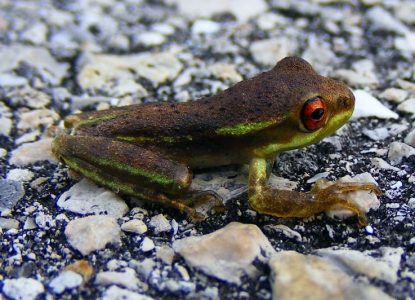
My soul searching journey will explore many of the identity contradictions that I live with.  I’m sure the journey will be long, but it will be worth it.  Maybe there will not be an end to it.  Maybe there doesn’t need to be an end, but an acknowledgement of the journey itself will be enough to find comfort and peace.  Life is a journey.  My coqui soul project is also a journey.

I’m happy to be in this journey with you, the reader.  Maybe you can also discover something about yourself along this journey.

I’m Still Puerto Rican