When I went to my first writing class, I had an encounter with one of the biggest dualities that I live with as a Puerto Rican in the United States. The example I will be sharing portrays a reality that I have lived with for many years, but that has been difficult to explain to myself. The situation is real and exemplifies many other situations throughout my life as a Puerto Rican in the United States.
I purposely decided to go to class early, as I have missed the first class and wanted to have a chance to meet the instructor. I had contacted the instructor by email after I registered for the writing class, but this was my first time in class. I entered the classroom and selected a desk. The instructor was in the room and recognized that I was new.
“Are you Ines?” the instructor asked.
“Yes,” I said.
The instructor then said, “Mucho gusto.”
(‘Mucho gusto’ means something like ‘nice to meet you’ in Spanish)
It is funny how this introduction reflected on many of the things that I have been thinking about before signing up for the class. I have sent the introductory homework piece to the instructor ahead of time, the title of which was ‘I’m Still Puerto Rican.’ Knowing about my piece, the instructor probably assumed that I spoke Spanish so she was trying to connect with me in my native language. What’s funny is that when I was confronted with the Spanish greeting, I naturally responded to her in English. I was not in a Spanish environment (I was in Michigan), so I didn’t think in Spanish. She proceeded to tell me that she knew a little Spanish.
In my head, I thought,
“That’s good, but I’m not speaking Spanish.”
What my head was thinking was brought up by the duality that lives inside me: Spanish vs. English; Puerto Rican vs. American. Of course, I didn’t say what my brain thought. That would have been rude or impossible for her to understand. I just nodded my head.
The instructor went on to tell me that the topic of duality that I shared in my introductory piece (‘I’m Still Puerto Rican’) was a good topic to explore. (The link to my introductory piece, I’m Still Puerto Rican, is included at the end of this post) The instructor’s comment brought a lot of hope and encouragement, as I have been thinking about this topic, and how to better understand it, for a while.
The duality of language – the way my brain works and reacts around both languages – was indeed an interesting topic to explore. I have debated a lot of questions about this topic throughout the years.
How I move from one language to the other. How it feels foreign and strange to think in Spanish while I’m here in Michigan. How I think in English every day of my life in Michigan. How I feel emotions in English. How it is easier for me to express my feelings in English. How I struggle in Puerto Rico trying to come up with Spanish words. How I have an accent in both languages. Yes, I have an accent in Spanish and English.
It should not be surprising that I think in English, as I have been in the States for over 34 years. I live and work in Michigan and my daily life happens in English, not Spanish. I only speak Spanish over the phone when I call my mom, or when I visit Puerto Rico. But even in Puerto Rico, it is hard for me to speak Spanish all the time, as my husband is not Puerto Rican and I don’t like to exclude him from what’s going on in a conversation. But sometimes I feel pressure to speak Spanish in Puerto Rico because that’s my native language and Puerto Rico is my native country.
Even with my sister, it is usually a mix of English and Spanish. We go back and forth, but English usually wins as we are expressing our feelings and emotions. My sister lives in Massachusetts and she has also been in the States for many years.
My husband is amazed that I can go from one language to the other. It might seem easy, but it is very difficult sometimes, especially when I’m trying to remember words in Spanish. Mostly, my language choice is determined by the environment where I am. If I’m in Michigan or anywhere in the States, there is no Spanish at all that comes to mind. When I’m in Puerto Rico around my mom and family, I speak Spanish. But there is an internal struggle that I try to hide as best as I can, although it becomes obvious to others when I’m forgetting words. Some friends in Puerto Rico brought to my attention that I have an English accent when I speak Spanish. That was quite a surprise to me. I know I have a Spanish accent when I talk in English, but now it happens both ways – English and Spanish.
Having an accent in both Spanish and English makes me think a lot about not belonging to either Puerto Rico or the United States. Sometimes I feel like a stranger in both places, which I will be exploring a lot more in this blog. This duality goes a lot deeper than just the language. The language duality triggers a lots of feelings (many I can’t explain). The language dichotomy awakens in me spurs of anxiety and uneasiness. I also realize that there is a confidence issue that comes up during the language struggles. For some strange reason my mind goes to a lot of places when I meet someone in the States and they quickly ask me where I am from. I have always assumed that they are asking me the question because they detect an accent. They don’t ask that question to my husband when we are together.
My usual response – and I have gotten better at it with time – is: “I’m from Michigan, but I’m originally from Puerto Rico.”
I always feel the urge to explain and clarify the situation. I have gotten pretty good at my answer. My husband usually observes with curiosity. He knows what’s going on in my head. He knows that the ‘question’ bothers me because it triggers a lot of weird emotions in my head. This is one of the reasons why I’m going through this soul searching journey.
Being a Puerto Rican in the United States, with an accent I should add, creates some complicated reactions in my head. My brain tells me that when I’m being asked the ‘question’ somehow it pinpoints the fact that I’m different – I have an accent, I have brown skin, I look different from other people in the room (most of the time). Being different brings awareness about being a Hispanic minority in the States. Somehow I feel like an outcast.
I know that the language issue and my reactions to the question of ‘where am I from’ exemplify the tangle of emotions that arise with my search for identity. My soul feels pulled by two different forces that clash. Am I Puerto Rican? Am I American? Theoretically, I’m both because as a native Puerto Rican, I’m also an American citizen. But sometimes I feel that I’m neither. I think the key is that I’m actually a combination of both identities, and maybe a lot of other things that I identify with.
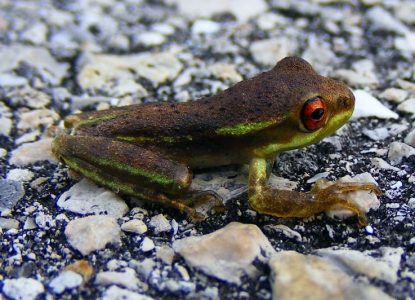
My soul searching journey will explore many of the identity contradictions that I live with. I’m sure the journey will be long, but it will be worth it. Maybe there will not be an end to it. Maybe there doesn’t need to be an end, but an acknowledgement of the journey itself will be enough to find comfort and peace. Life is a journey. My coqui soul project is also a journey.
I’m happy to be in this journey with you, the reader. Maybe you can also discover something about yourself along this journey.
 My Coqui Soul Project